The Next Wave of Efficiency: Are You Ready for Intelligent Automation?
 May 12, 2025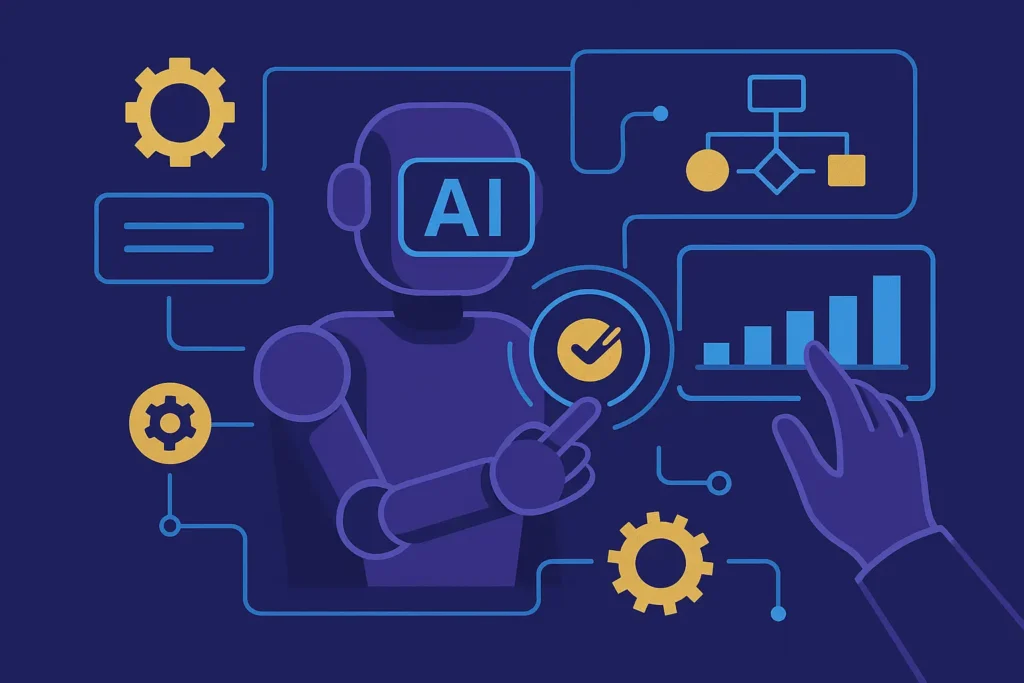
For years, Business Process Automation (BPA) has been a key driver of efficiency. Organizations have successfully automated the structured, repetitive, and rule-based tasks that were once performed by humans. This has allowed them to reduce costs, minimize errors, and accelerate their operations.
However, this first wave of automation has a significant limitation: it can only handle the predictable parts of a process. The moment a process requires cognitive work, such as reading an unstructured document, understanding a customer’s intent, or making a judgment based on incomplete information, the automation breaks down, and a human must intervene. The next wave of efficiency lies in overcoming this barrier with Intelligent Automation.
- What is Intelligent Automation?
Intelligent Automation (IA), also known as hyper automation, is the combination of traditional process automation with the power of Artificial Intelligence and Machine Learning. It is about automating not just the “doing” but also the “thinking.”
An IA platform can see, read, and understand information in much the same way a human can. This allows it to handle the unstructured, cognitive tasks that have always been the exclusive domain of your knowledge workers.
- Reading and Understanding Your Documents
The single biggest roadblock for traditional automation is the unstructured document. Automation cannot process an invoice, a contract, or a customer email if it cannot read and understand the content.
“Intelligent Automation gives your processes eyes to see and a brain to understand, finally removing the paper barrier to true end-to-end automation.”
Intelligent Document Processing (IDP), a core component of IA, uses AI to automatically classify document types and extract critical information. For example, it can read a scanned invoice, identify the vendor’s name, invoice number, and total amount, and then feed that structured data directly into the next step of an automated workflow, all without human intervention.
- Predicting Outcomes and Making Smarter Decisions
Traditional automation is good at following a pre-defined set of “if-then” rules. But what if the best path forward is not always clear?
Intelligent Automation can use machine learning to analyze historical data and make predictive decisions. For example, it can analyze an incoming customer complaint and, based on its content and sentiment, predict the best department or even the specific agent to route it to for the fastest resolution. It can also monitor workflows for signs of potential delays and proactively escalate a task before a deadline is missed.
- Augmenting Your Human Experts
The goal of Intelligent Automation is not to replace your skilled employees, but to supercharge them. By automating the low value cognitive work, you free up your experts to focus exclusively on the high value, strategic parts of their job.
An investigator can spend their time analyzing the facts of a case rather than manually collecting documents. A customer service agent can focus on solving a customer’s problem rather than keying in data from a form. IA acts as a powerful digital assistant for every employee, boosting their productivity and their job satisfaction.
Embracing the Future of Work
Intelligent Automation represents a fundamental shift in how we think about efficiency. By combining the power of AI with the discipline of process automation, you can unlock a new level of productivity, create more agile and responsive operations, and empower your employees to achieve more than ever before.
Transform your business processes with the power of AI and Intelligent Automation.