The Elephant in the Room: Taming Your Physical Records Before They Become a Liability
 June 16, 2025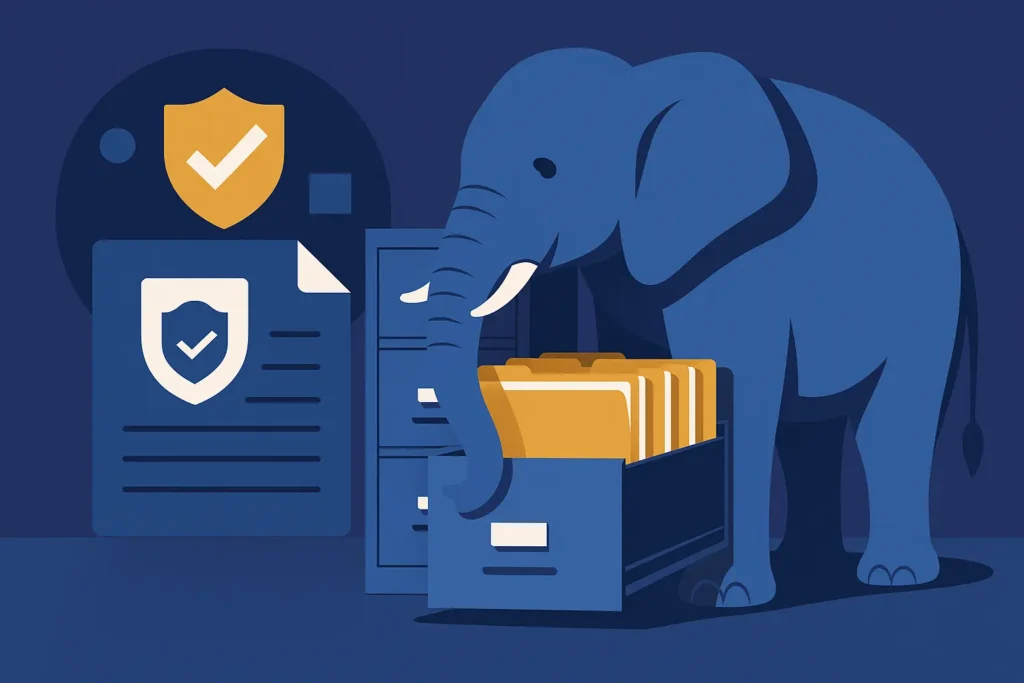
In the drive toward digital transformation, it is easy to focus exclusively on electronic data. But for most established organizations, a massive amount of critical information still exists on paper, stored in filing cabinets, on site file rooms, and expensive offsite warehouses. These physical records are the “elephant in the room” of information governance.
When managed with spreadsheets and manual processes, your physical archives become a source of significant risk, cost, and inefficiency. A modern, hybrid approach to Records & Archiving brings these physical assets under digital control, transforming them from a liability into a managed and compliant part of your corporate memory.
- The Compliance Blind Spot
Your organization’s retention policies must apply to all official records, regardless of their format. However, it is nearly impossible to consistently enforce these policies on physical documents that are tracked manually.
How can you prove to an auditor that a specific box was destroyed on time? How do you apply a legal hold to paper files that may be scattered across multiple locations? This lack of a defensible audit trail for your physical records creates a major compliance blind spot that can lead to severe penalties.
- The Hidden Costs of Storing Paper
Physical storage is expensive. Whether it is the cost of real estate for an on site file room or the monthly fees from an offsite storage vendor, storing paper costs real money. Without a systematic way to identify and dispose of records that have passed their retention period, organizations often end up paying to store boxes of unnecessary documents for years, or even decades.
“Every box of records you store beyond its legal retention date is not just a compliance risk; it is an unnecessary and recurring cost to your business.”
- The Inefficiency of the Manual Hunt
When a specific physical file is needed for a customer request, a legal matter, or a business query, the retrieval process is often a slow and painful manual hunt. An employee must first try to figure out which box the document might be in and then physically travel to the storage location to search for it.
This process can take hours or even days, bringing your business processes to a halt while you wait for a piece of paper. This inefficiency is a direct cost to your business and leads to frustrating delays for both employees and customers.
- Bridging the Gap with a Hybrid Approach
A modern Records & Archiving platform solves these problems by creating a “digital twin” for every physical asset. The solution does not require you to scan every document, but rather to manage your physical inventory digitally.
- A Digital Inventory: You can create a complete, searchable inventory of all your physical assets, from warehouses and rooms down to individual boxes and files.
- Barcode Tracking: By labeling each box or file with a unique barcode, you can use simple mobile scanners to track its exact location and manage a full chain of custody.
- Unified Policy Management: You can apply the same automated retention and disposition policies to both your physical and digital records from a single platform. When a box is due for destruction, it will automatically appear on an approval workflow.
- Electronic Request Management:Employees can electronically search for and request a physical file. The system then generates a work order for a records manager, telling them the exact location of the item.
From Liability to Visibility
By bringing your physical records under digital governance, you can close your compliance gaps, reduce storage costs, and dramatically improve the efficiency of your operations. A hybrid approach provides a single source of truth for your entire corporate memory, ensuring your digital transformation is complete.
Gain total visibility over all your information assets with our unified Records & Archiving solution.